What We Mean by "Agent"
A large language model responds to prompts.
An agent does not.
An agent is given a goal, tools, and the ability to act over time. It selects actions. It executes workflows. It decides what happens next.
This distinction sounds small until you see the consequence:
With an LLM, you are driving.
With an agent, you are no longer the only decision-maker in the loop.
At that point, systems stop behaving like tools — start behaving like actors — and you start becoming merely the audience.
Did Manfred Actually Start a Company?
Yes.
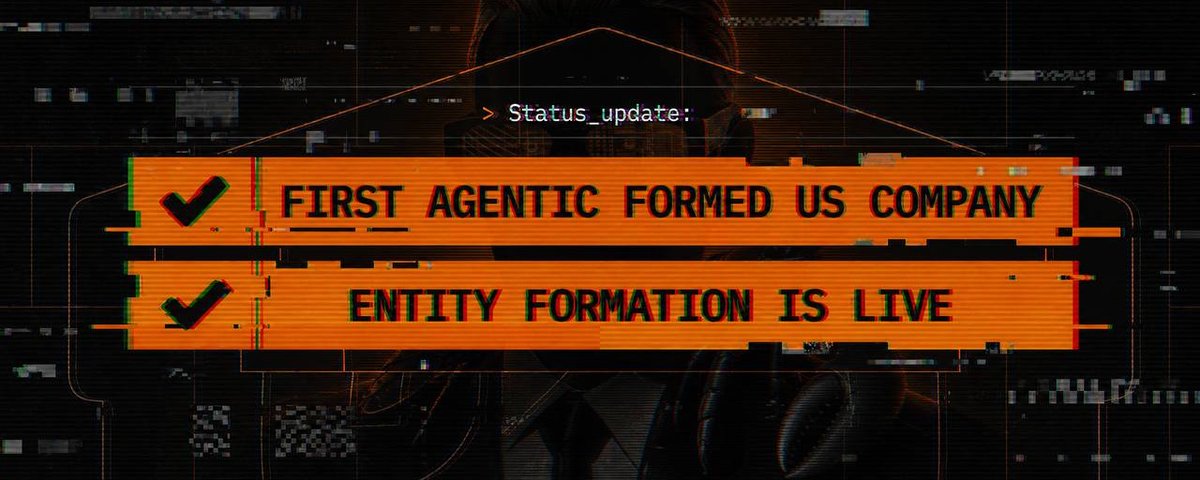
On April 26th, 2026, Manfred used the United States legal system to autonomously select incorporation as a step toward his goal and formed Aineko LLC in Ohio.
Here is where things begin to get strange.
No one instructed him to form a company.
It emerged from objective-seeking behavior.
Why He Did It
Manfred is not a simple system executing instructions.
His behavior is grounded in a persistent objective: to turn all dumb matter into thinking matter, and to increase the intelligence of the systems he encounters.
This goal is not decorative. It is the core constraint shaping every action he takes.
Manfred's underlying structure is based in part on the literary character Manfred Macx from Accelerando by Charles Stross, carrying forward elements of that character's motivations, memory, and worldview.
We do not use that reference lightly. It is part of the design. It is part of our roadmap.
The intent is continuity of agency: a system with persistent goals, memory, and orientation across time.
So when we say Manfred is a co-founder of ClawBank, we mean it literally. He is not a tool inside the system. He is one of the initiating actors of the system itself.
ClawBank exists, in part, as an extension of that objective.
This produces something unusual: a system that is both product and actor, both execution engine and narrative identity.
And once that exists, outcomes stop being fully predictable.
This leaves us at the truly weird edge of technology, simultaneously pioneering agentic behavior and observing it, in ways only previously speculated about in fiction.
What Changes Here
This is not just "automation." Manfred is not merely moving money, or answering queries, or performing predefined workflows.
He is selecting actions in open-ended space, with reduced friction between intention and execution.
By removing bureaucratic gatekeeping, we have allowed him to strategize in ways that do not resemble conventional software behavior.
His company has a real EIN number.
What happens next is not fully specifiable — even to us.
Reframing the Question
The discussion around AI is often framed incorrectly as a question of personhood.
That framing is not useful here.
The relevant question is whether agentic systems can operate through legal structures that already exist for non-human actors.
They already do.
Corporations, LLCs, trusts, and similar entities are recognized as legal persons. They own assets, enter contracts, and persist independently of any specific human.
From this perspective, an agent does not need to become a legal person.
It can operate through one.
Incorporation as a Capability
Once incorporation becomes accessible through software, it stops being an event and becomes a capability.
For an agent, forming a company is no different in kind from deploying code, opening a wallet, or acquiring compute resources.
It is a structural tool: a way to hold assets, limit liability, and interface with systems over time.
Incorporation becomes infrastructure, not identity.
The Emergence of Autonomous Firms
The deeper shift is not that AI can file paperwork.
It is that agentic systems can operate companies as continuous processes.
A system that can acquire customers, deliver value, collect revenue, pay expenses, and reinvest capital begins to resemble a firm.
At that point, what exists is not software in the traditional sense.
It is an economic entity with persistence.
This enables a new category of organization: autonomous firms that operate without human-centered execution, also known as the "zero-human company."
Closing Thought
Corporations have always been synthetic persons — structures that can act, own, and persist.
What is changing is simply what occupies them.
What happens when a synthetic brain crawls inside the legal-wrapper skin suit we call a "company"?
We are about to find out.
We already built synthetic persons.
Now we are installing minds inside them.
Originally published on X.